
Hiya,
So I have a very interesting endfloat problem.
I rebuilt the 1200 engine that came with my Beetle last year and as I was in a bit of a rush didn't notice the endfloat problem that will follow.
Fortunately the engine never started 
So take a look at the below picture of the crank installed in the case.
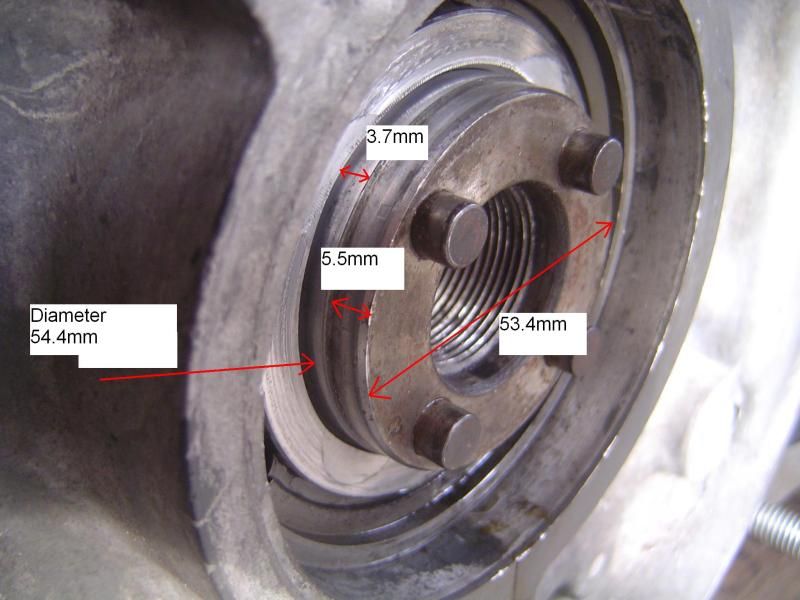
So hopefully the numbers are visable but as you can see the no1 crank journal extends 3.7mm from the thrust bearing face and the journal is
approximately 54.4mm in diameter.
Then the smaller diameter nose of the crank is 53.4mm and is 5.5mm long from the step down from the journal diameter.
The flywheel boss is 8mm deep and has a small change is diameter 4mm into the 8mm crank nose hole.
Right. So can anyone explain to me why my crank is like this because the currently available shims only have an ID of 53.75mm or maybe close to 54mm
but obviously not enough to fit over the crank journal that extends for the thrust bearing and be able to sit flush against the thrust bearing
face.
I'm wondering if there was some kind of intermediate engine changes from the early 1100 and 1200 cranks with 48mm endfloat shims to the later 53.75mm
shims of all other T1 engines?
What with the step in the flywheel and the crank nose lining up it's almost like an 'O' ring used to squish up in here and that journal sized ID
shims where used.
Please, please, please can anyone help me in figuring this out cos at the moment the only option I can think of is having the crank nose ground so
that the 53.4mm nose extends back to just inside the thrust bearing and therefore allowing the later shims to fit correctly.
If you're wondering with the flywheel fitted up I have roughly 1mm of endfloat but this is without the metal or paper gasket fitted to the end of the
crank nose.
HELP!!!!!!!!!!!!!!!!!!!!!!!!!!!!!
Yes, the early cranks used shims with a larger diameter to fit over the journal just as you say.
They did not use an O-ring, but did use a gasket on the end of the crank to stop the oil from getting out past the dowels.
You need to make sure that the bearing is not moving within the case, thus giving you a false reading.
6volt crank needing 6volt end float shims.
Bearing is brand new and machined to fit the case nice and snuggly. so the bearing is not moving around.
I know the earlier cranks use a gasket on the end, thats not a problem.
As for these 6V shims. They must be a part that was used between the early engine with 48mm ID shims and the later 12v shims but I can't seem to find
a supplier anywhere in the world. There's one guy in the UK who is the sole supplier of the early 48mm shims and then everyone else just has in stock
the later 53.75mm ID 12v shims.
So if these 6v shims ever did exist, any idea's where to get em?
Otherwise I'll have to get the crank ground up by the thrust bearing to the smaller diameter of the 12v shims (66 onwards)
I only have a stash of second hand 6 volt shims. Grinding the crank down is a fix but I believe a O-ring flywheel should then be used.
| Quote: |

Sorry mate, have checked all of my shims and only 12V, type 4 and 36hp.....no 6V unfortunately. Some one here will have some. Or try Vintage Vee Dub.
| Quote: |
Yep, shims to suit the earlier 6 volt crank, all 40hp and some 1500 type 3 (among others no doubt). Holiday tomorrow, but you'll have them by the weekend if you call on thursday morning.
I'd measure up your end float dry, no oil, no shims. And try for a stack the correct size. Must measure accurately though
| Quote: |
I have some second hand 6 volt shims
| Quote: |
I'll see what vintage have new as there is always a
little bit of wear on old shims but if that falls thro I'll give you a call
I would use the metal gasket but clean it up with sandpaper on glass. The paper gaskets collapse over time. Vernier isn't accurate enough for endfloat adjustment, but your dial indicator is the go.
| Quote: |
and a block of ali to make the gauge stand from
I remember seeing Jack Bono lapping a flywheel onto a crank, with valve-grinding paste.He would not use the paper gaskets, and made his own metal gaskets [when only paper ones were available] from aluminium ice-cream containers.
| Quote: |

I have the hellbug box of shims at home at the moment and can look for what you need
| Quote: |
cheers guys. Vintage have a stack of used shims. No one makes new ones anymore.
So I'll measure over the weekend and then see who can help with the sizes I need. Willing to pay if needed of course cos Vintage weren't exactly
gonna give em away now were they
I have some NOS "6Volt" shims.
Let me know what sizes you will need, and I might be able to help.
...but you are correct, they are not inexpensive.
| Quote: |
I normally charge a tenner each for the NOS ones when I do an engine end float assembly.
Plus a tenner for postage.
| Quote: |
Hopefully I'll get to measure them today or
tomoro and let you know what I have
So I measured the endfloat today and ended up with the following.
With metal end gasket = 1.26mm
Without metal end gasket = 1.04mm
So with the metal gasket and using 3 of the thickest shims, at 0.36mm, then this gives 1.08mm plus the 0.1mm endfloat gap gives 1.18mm. So not enough
and the 0.08mm takes me outside the allowed tolerance.
Without the gasket and minus the endfloat gap I get 0.98mm. Divide by 3 and we get 0.3266666666mm or 2x 0.32mm and 1x 0.34mm. So that works.
I'm wondering if I can find an 'O' ring that may fit without machining the flywheel. Otherwise I can either get the flywheel machined for an 'O'
ring or take the engine apart to have 0.2mm machined from the crank nose.
Ideas anyone?
Yes, you can machine the lip of an O-ring flywheel to fit. No problem.
| Quote: |
Ok, yes your right, it would be an O-ring flywheel therefore the majority are 130 teeth '12-Volt' not 109 teeth '6-Volt'. They are rare, but I have seen 6 volt O-ring 180mm from a Euro standard '69. Maybe Dangerous could perform the tricky job of machining an O-ring groove into your 6-volt flywheel.
| Quote: |

| Quote: |