A.k.a.: Bronze
Custom Title Time!
Minister of Volkswagenism
Posts: 1922
Threads: 238
Registered: September 1st, 2002
Member Is Offline
Location: Toronto - Westlakes NSW
Theme: UltimaBB Pro Blue ( Default )
Mood: Enlightened.
posted on January 23rd, 2004 at 03:17 AM
Top Fuel - How far can you go?
I can across this while waiting to get tired. I though some of the people in here could appreciate these stats.
I know these don't relate to VW so much but it did make me think about that sweet VW Dragster we saw at the Nationals. I fairly sure VW Top Fuel
has been tried from a previous search but had no luck this night finding anything. Regardless there is no denying the awesome stats from V8
super-charged nitro.
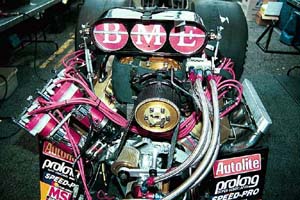
TOP FUEL DRAGSTERS INFO
One dragster's 500-inch Hemi makes more horsepower then the first 8 rows at Daytona.
Under full throttle, a dragster engine consumes 1 1/2 gallons of nitro per second, the same rate of fuel consumption as a fully loaded 747, but with
4times the energy volume.
The supercharger takes more power to drive then a stock hemi makes.
Even with nearly 3000 CFM of air being rammed in by the supercharger on overdrive, the fuel mixture is compressed into nearly-solid form before
ignition.
Cylinders run on the verge of hydraulic lock.
Dual magnetos apply 44 amps to each spark plug. This is the output of an arc welder in each cylinder.
At stoichiometric (exact) 1.7:1 air/fuel mixture (for nitro), the flame front of nitro methane measures 7050 degrees F.
Nitro methane burns yellow. The spectacular white flame seen above the stacks at night is raw burning hydrogen, dissociated from atmospheric water
vapor by the searing exhaust gases.
Spark plug electrodes are totally consumed during a pass. After 1/2 way, the engine is dieseling from compression plus the glow of exhaust valves at
1400 degrees F. The engine can only be shut down by cutting off it's fuel flow.
If spark momentarily fails early in the run, unburned nitro builds up in those cylinders and then explodes with a force that can blow cylinder heads
off the block in pieces or blow the block in half.
Dragsters twist the crank (torsionally) so far (20 degrees in the big end of the track) that sometimes cam lobes are ground offset from front to rear
to re-phase the valve timing somewhere closer to synchronization with the pistons.
To exceed 300mph in 4.5 seconds dragsters must accelerate at an average of over 4G's. But in reaching 200 mph well before 1/2 track, launch
acceleration is closer to 8G's.
If all the equipment is paid off, the crew worked for free, and for once NOTHING BLOWS UP, each run costs $1000.00 per second.
Dragsters reach over 300 miles per hour before you have read this sentence.
Top Fuel Engines ONLY turn 540 revolutions from light to light!
The redline is actually quite high at 9500rpm.
To give you an idea of this acceleration, the current TF dragster elapsed time record is 4.477 seconds for the quarter mile. This means that you could
be coming across the starting line in your average Lingenfelter powered "twin-turbo" Corvette at 200 mph (on a FLYING START) and the
dragster would BEAT you to the finish line FROM A DEAD STOP in a quarter mile distance!